You're Changing Your Grip Without Realizing It — And It's Wrecking Your Game
Here's a scenario that probably sounds familiar: you hop into a match feeling locked in. Your first few games? Clean. Your inputs feel sharp, your aim feels dialed, everything's clicking. Then the lobby gets harder, the stakes creep up, and somewhere around game three or four, things start to fall apart in ways you can't quite explain.
Your settings haven't changed. Your controller is the same one you've been using for months. But something is off.
Chances are, your grip shifted — and you had absolutely no idea it happened.
The Invisible Problem With How You Hold Your Controller
Grip migration is one of those issues that almost never shows up in gaming content because it's hard to see from the outside. Nobody's making highlight reels of the moment a player's palm drifted two millimeters down the back of their controller. But that small, unconscious repositioning is enough to throw off the entire mechanical chain that connects your brain to your inputs.
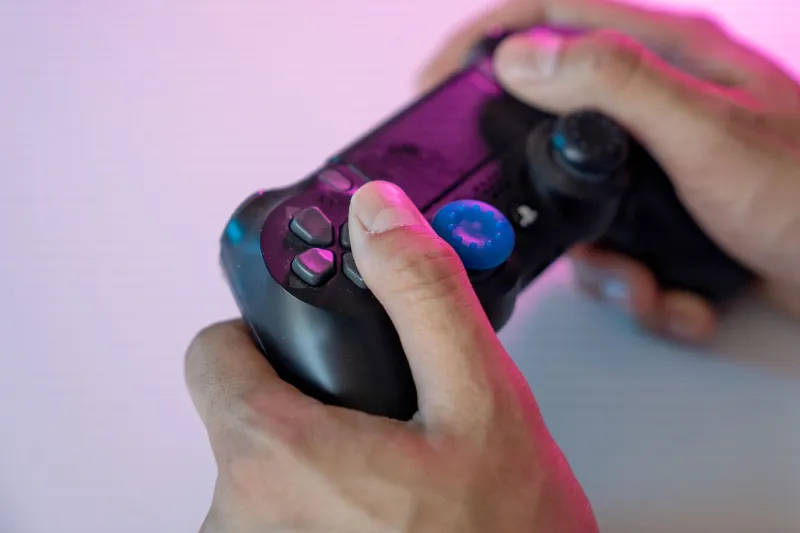
When you train with a consistent grip, your nervous system builds a very specific map. It learns exactly where your thumbs need to travel to hit a precise flick, how much pressure your index finger needs to register a clean trigger pull, how your wrists need to angle to keep everything neutral under load. That map is your muscle memory — and it's built around one fixed reference point: where your hands sit on the controller.
Shift that reference point, even slightly, and the map stops matching the territory.
Why Your Brain Moves Your Hands Without Asking You
So why does grip migration happen in the first place? The short answer is stress — but it's more layered than that.
When you're in a low-stakes match, your body stays relatively relaxed. Your grip is loose-ish, your breathing is steady, and your hands naturally fall into whatever position you've trained yourself to use. But the moment your nervous system registers pressure — a close match, a ranked game, a tournament bracket — things change at a physiological level.
Your muscles tighten. Your grip force increases. And without conscious awareness, your hands start searching for a position that feels more "secure." That usually means pulling the controller in closer, adjusting your palm placement for more surface contact, or subtly rotating your wrists inward. It's a comfort response. Your brain is trying to help you hold on tighter — but it's actually just moving the goalposts on your muscle memory.
There's also a fatigue component. Extended sessions cause micro-adjustments in hand positioning that compound over time. What starts as a millimeter of drift at the one-hour mark can turn into a legitimately different grip by hour three. And since the change is gradual, you never feel the moment it crosses the threshold.
What the Positional Shift Actually Costs You
Let's get specific about what changes when your grip moves.
Thumb arc is the big one. Your thumbstick control is entirely dependent on the angle and range of motion your thumb travels. If your palm drops lower on the grip, your thumb's natural resting position on the stick shifts outward. That changes your neutral point — the spot where you're not inputting any direction — and it changes the arc your thumb takes to reach the edges of the stick. In an FPS, that translates directly to aim consistency. In a fighting game, it affects the precision of your diagonal inputs. In any game that requires fine analog control, you're now operating with a slightly miscalibrated instrument.
Trigger depth is the other big casualty. Most competitive players develop a very specific trigger pull — a particular finger placement and depth of press that they've optimized for either speed or modulation. Change your grip, and your finger lands differently on the trigger face. That can mean the difference between a hair-trigger response and a pull that's a few frames slower than you expect. In a game where milliseconds matter, a few frames is not a small thing.
How to Actually Lock In Your Grip Under Pressure
The good news is that grip migration is trainable. It takes some deliberate work, but you can absolutely build the kind of consistency that holds up when things get intense.
Start by defining your grip on purpose. Most players have never consciously chosen their grip — it just kind of happened. Take ten minutes to sit down with your controller and figure out exactly where your hands are when you're playing your best. Note your palm contact points, where your thumbs rest at neutral, and how your fingers sit on the triggers and bumpers. This is your baseline. Write it down if you have to.
Use tactile anchors. Controller grips and textured wraps aren't just about sweat management — they create physical reference points that your hands can return to automatically. A grip with distinct texture zones or raised edges gives your palms something to orient against, which makes it much harder to drift without noticing. This is one of the most underrated reasons to invest in a quality aftermarket grip.
Train under simulated pressure. Practicing in low-stakes environments only trains your relaxed-state grip. To build pressure-proof consistency, you need to practice when your heart rate is up. That might mean jumping straight into ranked without warmup, playing against harder opponents than you're comfortable with, or even using something like a timed aim trainer session to create urgency. The goal is to expose your grip to the conditions where it tends to migrate, so you can catch and correct the drift before it becomes automatic.
Record yourself. This sounds awkward, but a quick phone video of your hands during a session is genuinely revealing. Set it up at an angle where you can see your palm and thumb placement, play a full match, and watch it back. You'll probably spot the exact moment your grip shifts — and more importantly, you'll see what triggered it.
Build a reset ritual. Some competitive players use a deliberate between-round reset — a specific moment where they consciously re-check their grip and return to baseline. This is especially useful in games with natural pause points like round-based shooters or fighting games. It takes two seconds, and it keeps the drift from compounding across a long session.
The Consistency Edge Nobody Talks About
A lot of gaming content focuses on the gear — the controller specs, the thumbstick tension, the trigger sensitivity settings. And all of that matters. But none of it means anything if your hands are in a different place every time you sit down to play.
Grip consistency is the foundation that everything else is built on. It's what lets your muscle memory actually work the way it's supposed to. And unlike raw mechanics or game sense, it's something you can improve dramatically in a short amount of time just by paying attention.
Your controller hasn't been the problem. Your hands have been quietly going rogue — and now you know how to stop them.