Too Many Controllers, Not Enough Game: The Hidden Cost of Building a Controller Collection
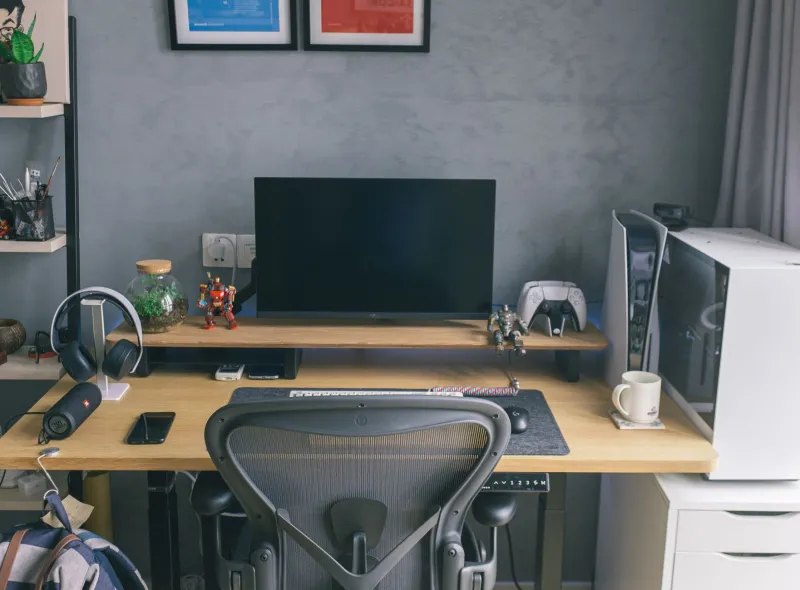
There's a specific kind of gamer logic that sounds completely reasonable until you say it out loud: I need a different controller for each genre I play.
Fighting game? Hall-effect arcade stick. Competitive FPS? High-end asymmetric pad with hair-trigger locks. Racing sim? Dedicated wheel and pedals. RPG nights? That beat-up old Xbox controller because it just feels right for exploration.
Before long, you've got a shelf that looks like a GameStop clearance section, a wallet that feels noticeably lighter, and somehow — somehow — you're still losing ranked matches.
So what's actually going on here?
The Gear Acquisition Spiral Is Real
Let's call it what it is: gear acquisition syndrome, or GAS, is a documented phenomenon in audio and music communities that translates almost perfectly to gaming. The core loop goes like this — you hit a performance plateau, you look for an external explanation, you find a piece of gear that might fix it, you buy it, you feel a short burst of renewed motivation, and then the plateau returns.
Repeat until your credit card cries.
The gaming controller market has gotten very good at feeding this loop. With premium pads now ranging from $70 on the low end to well over $200 for something like the Xbox Elite Series 2 or a fully customized Scuf, there's always a next-level option sitting just above what you currently own. And the marketing is smart — it speaks directly to competitive instincts, promising faster inputs, better ergonomics, and edges that your current setup supposedly can't deliver.
None of that is entirely wrong, either. That's what makes it so easy to justify.
What Multiple Controllers Are Actually Doing to Your Muscle Memory
Here's the part nobody really talks about when they're building out their controller collection: your hands are constantly taking notes.
Every hour you spend with a specific controller is your nervous system logging data — button travel distance, grip width, trigger resistance, stick tension, the exact angle your thumb rests at neutral. Over time, that data becomes automatic. You stop thinking about the hardware and start just playing.
When you rotate between three or four different controllers, you're essentially asking your hands to maintain multiple sets of notes simultaneously. The muscle memory never fully consolidates. You're always doing a small amount of recalibration every time you pick up a different pad, even if you don't consciously notice it.
In casual play, this is basically irrelevant. But if you're trying to climb ranked, compete seriously, or shave reaction times down to the millisecond — that constant micro-adjustment is a real tax on your performance. You're never fully home in any one setup.
The Cost-Benefit Math Nobody Wants to Do
Let's run the numbers honestly, because this is where the controller ecosystem trap gets uncomfortable.
Say you own four controllers averaging $100 each. That's $400 in hardware. Now ask yourself: how many of those controllers have you actually put 50+ hours into? Because research on skill acquisition is pretty consistent — meaningful improvement in any physical skill requires repetitive, focused practice. Splitting 200 hours of play across four different pieces of hardware gives each one 50 hours. That's not enough to build the kind of deep, automatic competency that separates good players from great ones.
Compare that to a gamer who drops $150 on one excellent all-around controller and puts 200 hours into it. That player's hands know that controller the way a chef knows their favorite knife. The investment compounds.
The math almost always favors depth over breadth — but depth is harder to market, so nobody's really out here selling you on it.
When Multiple Controllers Actually Make Sense
To be fair, there are legitimate cases where owning more than one controller is genuinely justified, and it's worth being honest about those.
Platform switching is the clearest one. If you're regularly playing on both PlayStation and Xbox — or bouncing between console and PC — some degree of hardware variety is unavoidable. The button layouts and ecosystem integrations are different enough that forcing one controller across all platforms can create its own friction.
Genre extremes also have a case. A proper racing wheel setup is so fundamentally different from a standard gamepad that it's not really competing for the same muscle memory. Same goes for a full-size arcade stick for fighting games. These aren't really "extra controllers" — they're different tools entirely, like comparing a golf putter to a driver.
Backup hardware is just smart. If you compete or stream, having a second identical controller as a spare is basic risk management, not collector behavior.
The problem isn't owning two or three controllers for genuinely different use cases. The problem is owning five variations of basically the same thing because each one offered a slightly different spec sheet that seemed compelling at the time.
A Framework for Deciding If You Actually Need Another Controller
Before you pull the trigger on your next purchase, run it through these four questions:
1. Can I clearly name the specific limitation my current controller is creating? Not a vague feeling that something better exists — an actual, identifiable problem. Stick drift, poor ergonomic fit, trigger response that doesn't match your play style. If you can't name it specifically, you probably don't have it.
2. Will I put at least 100 hours into this new controller in the next six months? If the honest answer is no, you're buying hardware you won't actually develop a relationship with. That's a display piece, not a performance upgrade.
3. Am I solving a real problem or a psychological one? Hitting a skill plateau feels bad. Buying new gear feels like action. Those two things are not the same thing, even though they can feel identical in the moment. Be honest with yourself about which one is actually happening.
4. What would I have to give up to justify this purchase? Not financially — in terms of focus. If buying a new controller means you'll split your practice time across two setups instead of one, the performance math probably doesn't favor the purchase, even if the controller itself is excellent.
Own Less, Grip Harder
The Game Gripper philosophy isn't about having the most gear. It's about having the right gear — and then actually mastering it.
The best controller you own is the one your hands know completely. The one where you've stopped thinking about the hardware and started just reacting. That level of familiarity doesn't come from rotating through a collection. It comes from commitment.
Buy smart, go deep, and let your hands do the rest.