Your Thumbs Are Sending You Warning Signs — Are You Actually Listening?
Photo: Muybridge, Eadweard, 1830-1904, Public domain, via Wikimedia Commons
Here's a scenario that probably sounds familiar: you're deep into a ranked session, maybe two or three hours in, and you start noticing your aim getting sloppier. Your reaction times feel a little slower. You write it off as tilt or fatigue, queue up again, and end up dropping two more ranks before logging off frustrated.
But what if it wasn't mental? What if your hands were literally running out of gas?
Thumb fatigue is one of the most overlooked performance limiters in competitive gaming, and according to sports medicine professionals who work with esports athletes, it's also a genuine injury risk that most players completely ignore until it becomes a serious problem.
What's Actually Happening in Your Hands
Dr. Lara Voss, a sports medicine physician who has consulted with collegiate esports programs, puts it plainly: "The muscles and tendons controlling fine motor movement in the thumb are not built for the kind of sustained, repetitive micro-movement that competitive gaming demands. We see patterns in gamers that are remarkably similar to what we see in musicians and assembly line workers."
The culprit is a category of injury called repetitive strain injury, or RSI. In gamers, it typically shows up as inflammation in the tendons of the thumb and wrist — conditions like De Quervain's tenosynovitis (a painful inflammation along the thumb side of the wrist) or general extensor tendinopathy. These don't usually arrive overnight. They build slowly, over months or years, and by the time most players notice something's wrong, the inflammation is already well established.
The concerning part? Many early symptoms get dismissed as normal gaming fatigue.
Warning Signs Worth Taking Seriously
Not all hand discomfort is a red flag, but some of it absolutely is. Here's what sports medicine professionals say to watch for:
Aching that persists after you stop playing. Normal fatigue clears up within an hour or two of rest. If your thumbs, wrists, or forearms are still sore the next morning, that's your body telling you something is inflamed.
A burning or tingling sensation. This can indicate nerve involvement, which moves the situation from "muscle fatigue" territory into something that warrants a professional opinion.
Reduced grip strength or pinch strength. If opening a water bottle or pinching something feels harder than usual after a long session, that's a measurable sign of overuse.
Pain that shows up earlier in each session. If you used to play four hours before feeling discomfort and now you're feeling it at two hours, the condition is progressing.
Grip Style Matters More Than You Think
Different controller grips put stress on different parts of the hand, and that changes your injury risk profile significantly.
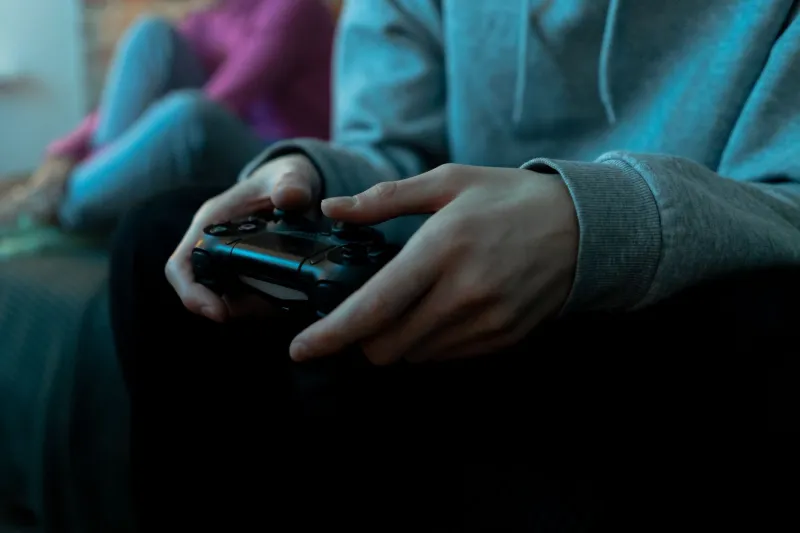
Palm grip players — those who rest the full controller in the palm with fingers draped naturally over the face buttons and triggers — tend to distribute stress more evenly across the hand. The thumb operates in a more neutral position, which is generally lower-risk for the thumb itself. The trade-off is more potential wrist strain during extended play.
Claw grip players, who curl their index finger to hit face buttons while keeping the thumb on the stick, put significant strain on the tendons running along the top of the hand. Over time, this grip style is associated with higher rates of extensor tendon issues.
Fingertip grip players — more common in PC gaming but present in controller play too — keep the hand in a more extended, elevated position. This can reduce palm fatigue but places more demand on the small intrinsic muscles of the hand, which tire quickly.
If you're already experiencing discomfort, your grip style is one of the first things worth evaluating.
Stretching Routines That Actually Work
Marcus Elroy, a physical therapist who works with esports athletes at a performance center in Austin, Texas, shared a quick routine he prescribes to his competitive gaming clients. The key, he emphasizes, is doing this before you play, not just after.
Wrist circles: Slowly rotate each wrist through its full range of motion, five rotations in each direction. This increases synovial fluid distribution in the joint.
Thumb opposition stretches: Touch your thumb to each fingertip in sequence, applying gentle pressure at each contact point for two to three seconds. This activates and warms up the intrinsic thumb muscles.
Prayer stretch: Press your palms together in front of your chest, fingers pointing up, and slowly lower your hands while keeping palms together until you feel a stretch in the wrist flexors. Hold for 20 to 30 seconds.
Extensor stretch: Extend one arm forward, palm facing down, and use the other hand to gently pull the fingers back toward your body. Hold for 20 seconds each side.
Elroy's recommendation: run through this sequence before every session longer than 90 minutes, and take a five-minute break every hour to do a shorter version of it mid-play.
Ergonomic Tweaks That Won't Slow You Down
Here's where a lot of injury prevention advice falls apart for competitive players — it asks you to make changes that feel like they're costing you performance. These suggestions are specifically chosen because they're low-impact on your gameplay:
Adjust your seating position so your elbows are at roughly 90 degrees. Playing with your arms extended or raised puts your forearm muscles in a partially contracted state for the entire session, accelerating fatigue.
Use a controller grip cover. Textured grip covers — the kind we've reviewed extensively here at Game Gripper — reduce the grip force you need to maintain control of the controller, which directly reduces tendon strain. You don't have to squeeze as hard when the controller isn't slipping.
Lower your controller's vibration intensity or disable it on long sessions. Haptic feedback requires your hands to subtly brace against the vibration continuously. Over hours, that adds up.
Keep your hands warm. Cold hands mean stiffer tendons and reduced circulation. If you're playing in an air-conditioned room, a short warm-up period or even keeping a hand warmer nearby makes a real difference.
When to Stop Playing and See Someone
If you're experiencing sharp pain, numbness, or swelling, stop playing and see a doctor — ideally one familiar with sports medicine or occupational hand therapy. Pushing through acute symptoms is how minor inflammation becomes a chronic condition that sidelines you for months.
For most players, though, the goal is to catch this stuff early. The warning signs exist for a reason. Your body's pretty good at communicating — the question is whether you're actually listening.
Take care of your hands. They're the whole game.